
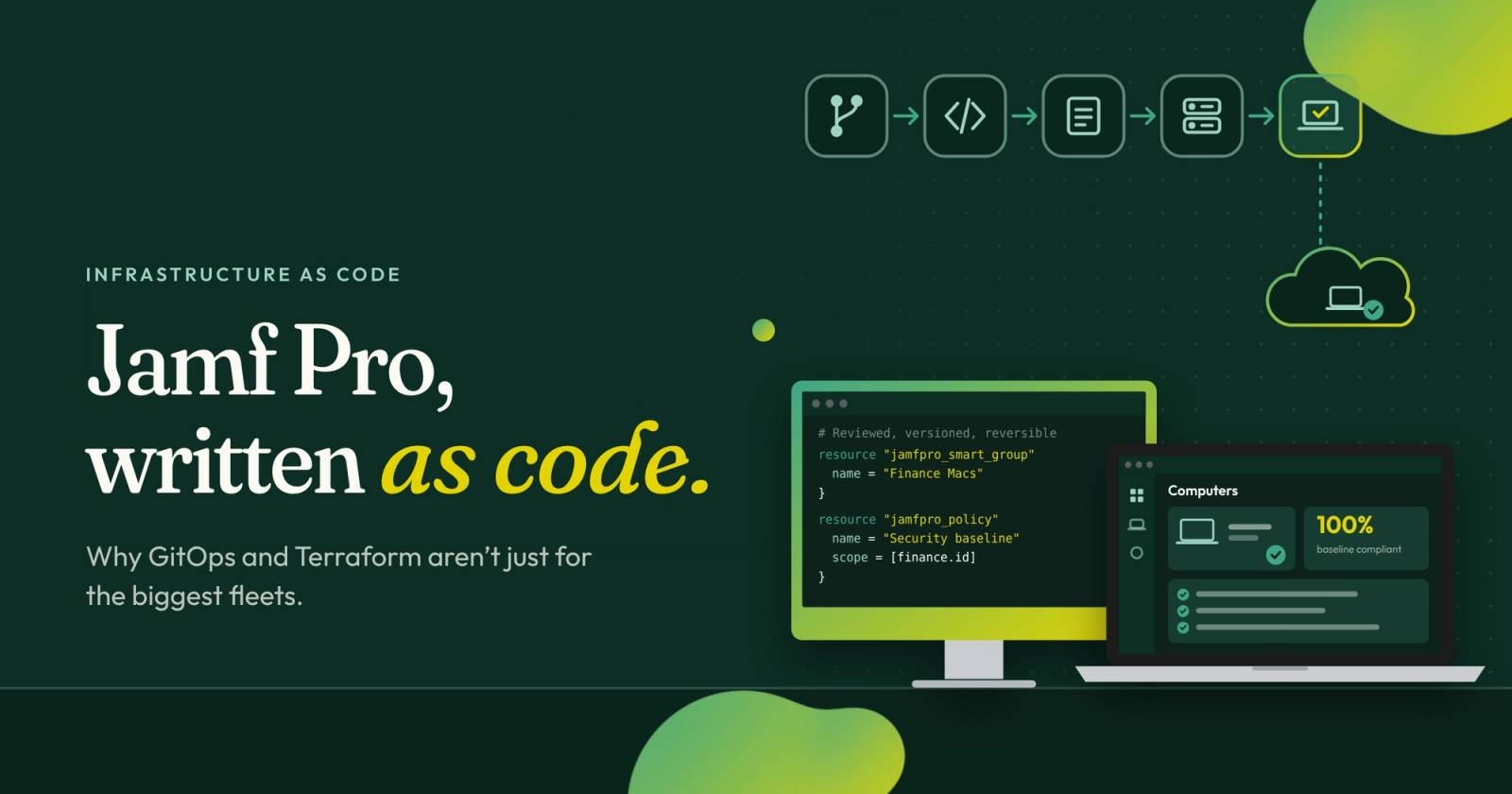

Most Jamf Pro servers are built by hand, or through ClickOps as it's become known. Someone logs in, clicks through a configuration profile, scopes it to a smart group and saves. It works, and for years it has been the only real option unless you were comfortable with the API and happy maintaining your own bash scripts.
Infrastructure as Code changes that. Instead of clicking, you describe your Jamf Pro configuration in text files, keep those files in Git and let a tool such as Terraform make the server match what the files say. Every profile, policy, smart group and script becomes something you can read, review, compare and roll back.
It isn't a new idea. Cloud and platform teams have worked this way for over a decade. What is new is that it has arrived in Apple device management, and the organisations talking about it on stage at JNUC are some of the largest Jamf customers in the world.
Who is already doing it
Infrastructure as code went from a niche session to a headline theme in the space of two JNUCs.
At JNUC 2025 in Denver, Jamf ran a session called Infrastructure as Code with Jamf, which included real world use cases from Vanguard. In the same week, a joint session from Netopie and Jamf showed how Git, CI/CD and Terraform automate Jamf Pro across more than 100 instances. Jamf also used the keynote to announce a Terraform provider for its new Platform API.
By JNUC 2026 in Kansas City it was everywhere. Jamf's own Day 1 recap described infrastructure as code, GitOps and Terraform turning up across the keynote stage and two of the ten best attended breakouts.
Lloyds Banking Group was at the centre of it. The Jamf Platform Terraform provider is already running in production at Lloyds, and their team joined the Platform State of the Union to talk about managing thousands of devices with Terraform. In a separate session, the Lloyds team explained how they took an eight person Mac team from no Git experience at all to fully owning a GitOps workflow for Jamf Pro.
Jamf has backed all of this with product. Its JNUC 2026 announcement describes a Terraform provider that manages the whole Jamf platform through code, with version control, peer review and rollback, and it is available now. This is no longer a community experiment.

Why the big teams do it
Listen to enough of these sessions and the same five reasons come up every time.
Accuracy. A configuration written once in code is applied the same way every time. No missed checkbox, no smart group scoped to the wrong criteria because someone was rushing on a Friday afternoon.
Keeping environments in sync. If you run a test server, a production server and a handful of regional or business unit instances, code is the only realistic way to keep them identical. Make the change once and promote it through each environment in turn.
Review before anything goes live. Changes are proposed as a pull request in GitHub or GitLab. A colleague reads exactly what will change, Terraform's plan shows the effect against the live server, and nothing is applied until it has been approved.
Rollback. When a change breaks something you revert the commit and apply again. You aren't trying to remember what a profile looked like last Tuesday.
An audit trail. Git records who changed what, when and why, with the approval attached. The Netopie and Jamf session made the point that this gives auditors the evidence they need without giving them access to the Jamf Pro console.
For a bank or a fintech, every one of those is close to mandatory. Change control and evidence are part of the job.
But what about 100 Macs and one server?
Most Jamf Pro customers don't look like Lloyds. A typical environment we see is one Jamf Cloud instance, around 100 Macs, and one or two people looking after it alongside everything else.
For that team the objections are fair. There is only one server, so there is nothing to keep in sync. There may be nobody else to review a pull request. Learning Git, Terraform, state files and a CI pipeline is real time that could go on the backlog instead. And the console works, so why add a layer between the admin and the thing they're managing?
We hear all of that, and we don't think anyone should adopt a tool because a bank did. The question is whether the benefits still hold when the multi tenant argument is taken away.

Why we think it still fits
We've been having this conversation with clients for a while now, and our view is that most of the benefits survive the move to a single tenant. Some of them matter more in a small team, not less.
Your configuration becomes its own documentation. In a team of one or two, the knowledge of why a profile exists usually lives in one person's head. A Git repository holds the what and the why in the same place. When that person is on annual leave or moves on, the next admin can read the server instead of reverse engineering it.
The reviewer doesn't have to be in house. Having no second admin is no reason to skip review, and it's where we see support changing, which we come to below.
Audit and change control still apply. Plenty of 100 seat organisations are working towards ISO 27001 or SOC 2, or answer to a client who expects evidence of controlled change. A pull request history is that evidence, produced as a side effect of doing the work.
One server rarely means one environment. A sandbox for testing macOS betas, a rebuild after a migration, or a fresh instance for a new subsidiary all become a matter of applying code you already have.
You don't have to codify everything on day one. Terraform can import objects that already exist. Start with the things that hurt most when they go wrong, such as your security baseline, your enrolment configuration and your compliance profiles, and leave the rest in the console until you're ready.

Support as a second pair of eyes
This is where we think infrastructure as code changes the relationship between a Jamf customer and their partner.
Today most support is reactive. Something breaks, a ticket comes in, and we work out what changed. Often nobody is quite sure, because the change was made in the console weeks ago and never written down.
With your Jamf Pro configuration in Git, that flips. You make the change you want and raise a pull request. We review it, check Terraform's plan against your live server and approve it, or come back with questions before anything reaches your Macs. Once it's merged the pipeline applies it, and the history records who asked for it and who signed it off.
You stay in control of your environment and keep doing the work yourself. We become the peer reviewer a team of one or two rarely has, bringing the context of having seen the same change go wrong somewhere else. Fewer surprises reach the helpdesk, and when something does go wrong there's a clear record and a quick way back.
Is this the future of device management?
We think the direction is clear, even if the pace isn't. At JNUC 2026 Jamf summed it up by saying it has gone from the platform you configure to the platform you build on. Blueprints, the Platform API and a first party Terraform provider all point the same way. The console isn't going anywhere, but more of what's new in Jamf is designed to be driven through an API first.
That doesn't mean every Mac admin needs to become a software engineer by next year. The Lloyds team started with no Git experience at all. What it does mean is that the skills are worth starting on now, while the stakes are low and you can learn on a sandbox rather than in production.
We're not going to pretend we have all the answers. Like most of the Mac admin community we're learning as the tooling matures, testing it against our own sandbox servers and talking it through with clients as we go. What we can do is help you work out whether it's right for you before you commit real time to it.
If you'd like to understand infrastructure as code at a high level first, before diving into resources, modules, GitHub Actions and CI/CD pipelines, we're happy to walk you through it. And we'd like to hear where you stand. Are you already managing Jamf Pro as code, thinking about it, or convinced it's overkill for your fleet?
Get in touch with the Dare team at hello@dare.tech.
Sources
- JNUC 2026 Day 1 recap, Jamf, 24 September 2026
- Platform State of the Union, JNUC 2026, Jamf, 23 September 2026
- Jamf takes Apple management into the AI era at JNUC 2026, Jamf press release
- Automating Apple endpoints management with Git, CI/CD and Terraform, Jamf, 13 October 2025
- Managing Jamf configuration with Terraform and GitOps workflows, Jamf, 24 December 2025